The “Plato” Paradox: Why a Robot Can’t Replace Human Educators
Last week, the East Room of the White House looked less like a hall of history and more like a set from a sci-fi film. As First Lady, Melania Trump introduced Figure 03—a sleek, multilingual humanoid presented as a glimpse into the future of teaching—the world was invited to imagine a classroom led by “Plato,” an AI tutor with infinite patience and every book ever written in its hard drive.
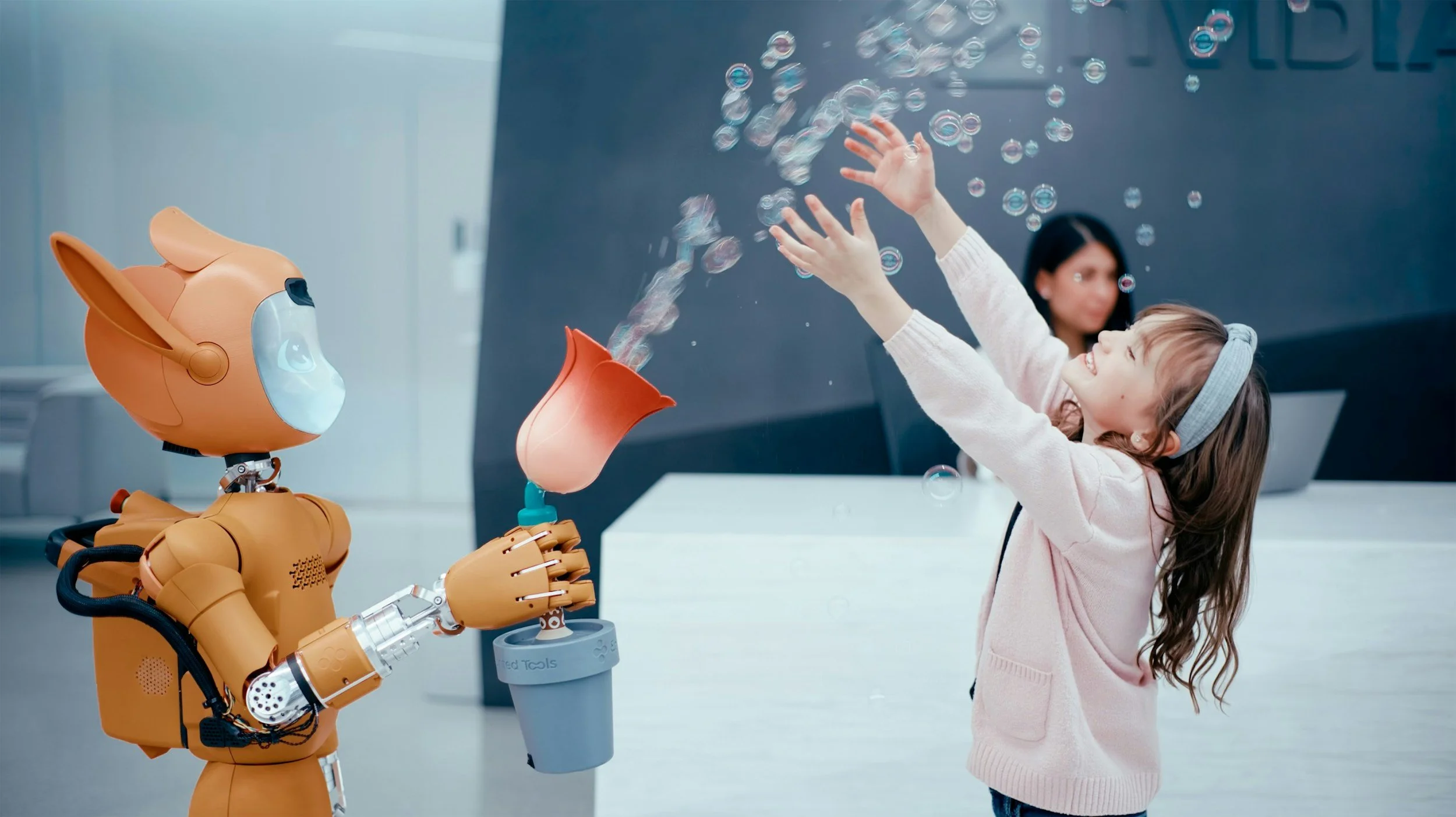
At HumanizEDU, we believe technology has a meaningful place in the future of learning. In fact, we believe in human-centered, technology-optimized solutions that can support teachers, strengthen schools, and expand what is possible.
But, as more attention turns toward silicon-based “solutions” for education, we have to ask a deeper developmental question:
Can a child truly learn from something that doesn’t have a heartbeat?
The research suggests the answer is more complex than an algorithm. This brings us back to one essential truth: human connection is not a bonus feature of education. It is the foundation. Without it, everything crumbles to the ground.
1. The “Social Gating” Problem: The Brain Prefers a Pulse
Neuroscience tells us that for a young child, the brain is not a bucket you simply pour information into. It has a gatekeeper. Dr. Patricia Kuhl’s Social Gating Hypothesis suggests that infants and toddlers are far less likely to comprehend phonetic and linguistic information unless it comes through live human interaction.
Why? Because human learning is not just informational. It is relational and biological. When a teacher looks a student in the eye, responds in real time, and shares focused attention, the brain registers that exchange differently. Research on “neural coupling” points to a human-to-human connection that supports attention and retention in powerful ways.
A humanoid may be able to simulate eye contact. But simulation is not the same as resonance. It cannot replicate the biological and relational “handshake” that tells a child’s brain:
You are safe. You are seen. This matters.
2. Co-Regulation: You Can’t Outsource a Nervous System
One of the truths at the heart of the HumanizEDU philosophy is this: learning commingles with the nervous system.
A child struggling with a difficult math problem, a writing assignment, or a social challenge is often not rooted in a cognitive issue. They are emotionally dysregulated, overwhelmed, discouraged, or disconnected.
A human teacher can sense that. They respond with tone, timing, presence, warmth, and authentic care. A calm voice. A reassuring glance. A pause. An encouraging word. These moments matter because they help regulate stress and restore safety in the body–this makes learning possible again.
A humanoid may be able to generate a patient response, but it cannot participate in the living, relational feedback loop of co-regulation that a human provides.
When we replace a teacher with a machine, we are not just removing an instructor. We are removing the foundation that attachment research tells us children need to take risks, recover from mistakes, and grow.
3. The “Intersubjectivity” Gap
Human teaching is more than delivering content. It is the ongoing practice of perceiving, interpreting, and responding to another mind.
A robot can detect that a student got Question #4 wrong. A human teacher can often sense why they got it wrong. They notice the hesitation in the hand, the shift in posture, the flicker of embarrassment, the creative reasoning behind the “wrong” answer, or the quiet moment that says, I don’t believe I can do this.
This is the space of intersubjectivity, the meeting of two minds. It is also where mentalization lives: the human capacity to consider what another person may be feeling, intending, fearing, or trying to express.
That is not a small part of teaching. That is teaching.
If one of those “minds” is actually wrapped in plastic and code, the relationship remains incomplete, and the risk is not only academic. We risk raising a generation that becomes increasingly fluent in producing correct answers while losing capacity in the deeply human capacities of empathy, context, ethics, and discernment.
Bringing the Human Back to the Center
At HumanizEDU, we see real potential for AI to support the parts of education that are repetitive, administrative, or data-heavy. Used wisely, technology can create more space for what matters most.
But we must draw a clear line:
Instruction is not the same as education.
Instruction is the transfer of information.
A machine can help with that.
Education is the formation of a human mind.
That requires a human.
If our leaders believe humanoids are the future of teaching, they may be missing one of the most important findings of the last century of developmental and educational research: education is a relationship.
As we move into 2026, our mission cannot simply be to make learning more efficient–but to make it more human. The real opportunity is not to replace teachers with machines, but to use technology in ways that free human teachers to do what only they can do best: mentor, co-regulate, and connect.
Because a “Plato” that can speak eleven languages but not understand the meaning of a single tear will never be enough.
The future of education is not a super brain wrapped in metal and plastic.
It’s us. It’s humans.
Join the conversation at HumanizEDU. How are you keeping the human at the center of your classroom, your leadership, or your school community this year?
#HumanizEDU #FutureOfEducation #HumanConnection #MeWeSchool